#6 It's all Pulp Fiction

In my opinion, Pulp Fiction is one of the greatest films ever made. At a young age, probably younger than I should’ve been, I was exposed to Quentin Tarantino through his film Kill Bill Vol. 1. I stumbled through my grandpa’s living room as he and my older brother were watching, and shooed me out of the room. I was petrified by the amount of blood I saw and wasn’t properly reintroduced to Quentin Tarantino until high school. I started with Kill Bill Vol. 1 and 2 and then went to Pulp Fiction. Through its groundbreaking and iconic non-sequential storytelling, immaculately dense dialogue that is anything but succinct, and use of soundtrack and sound design as its own storytelling device, Pulp Fiction solidified Quentin Tarantino’s title as an auteur of film.
While Pulp Fiction isn’t my personal favorite (I still can’t get over Kill Bill’s mixture of martial arts films and the Spaghetti Western), I would be very remiss to say Pulp Fiction didn’t lay the foundation for what Mr. Tarantino would accomplish in Kill Bill. Prominently displayed in both films is a storyline that is anything but straightforward. In Pulp Fiction, we open up on a diner that is soon robbed by a couple whose banter we watch for minutes preceding. Just as the couple’s antic begins, the film cuts to the title sequence. From then on out, the film bounces to Vincent Vega and Mia Wallace. This situation swirls into a flashback with Christopher Walken discussing a gold watch, which leads into the story of Bruce Willis’ character, Butch (who we are introduced to earlier in the film as an associate of Marsellus Wallace). Butch’s narrative eventually draws back to Vincent and Jules (Vincent’s business partner). These stories are told circularly; each leads into the next, where it’s hard to identify a true beginning and an end. It’s difficult to write a well-written story in a straightforward plot structure, so what Quentin has done with his storyline in Pulp Fiction is pure genius.

What next stands out to me, and what Quentin Tarantino is stylistically known for, is his witty, vulgar, indirect dialog. Take the first scene in Pulp Fiction: a couple sits at a diner discussing why robbing a bank isn’t a great idea. This interaction leads to the man suggesting the diner, which they do. In the second scene, two men are on their way to retrieve a suitcase for their boss, Marsellus. The entire dialog leading up to the next scene is John Travolta as Vincent goes on a diatribe about Quarter Pounders from Mcdonald's and what they are called in France (Royal with Cheese). As the men continue their journey, they go into another tangent of a former employee of Marsellus who gives his wife a foot rub. Marsellus wasn’t too happy and threw this man off a four-story building. Later on in the film, Christopher Walken has a famous monologue that is about Butch’s great (-great?) grandfather saving this watch through the holocaust by hiding it up his bum. These are just the iceberg of a Tarantino script. What the characters say, what they avoid, is just as important as what happens In a Quentin Tarantino film. Witty banter and quippy one-liners will always be aplenty, along with coarse vulgarities sprinkled in with intelligent, relevant commentary.
One of the best components of a Tarantino film is undoubtedly its score. In Pulp Fiction, Quentin Tarantino foregoes the traditional orchestral film score that was seen in many films thanks to Star Wars popularization of it. Instead, he enlists a robust soundtrack of surfer rock and pop songs. I think no better example is the title song, “Miserlou” by Dick Dale, which plays in the title sequence. It’s catchy, upbeat, and totally tubular. Other surfer rock songs include “Bustin’ Surfboards” by The Tornadoes, “Surf Rider” by The Lively Ones, and “Comanche” performed by Th Revels. But surfer rock only not Fiction Pulp is, as Yoda would say.
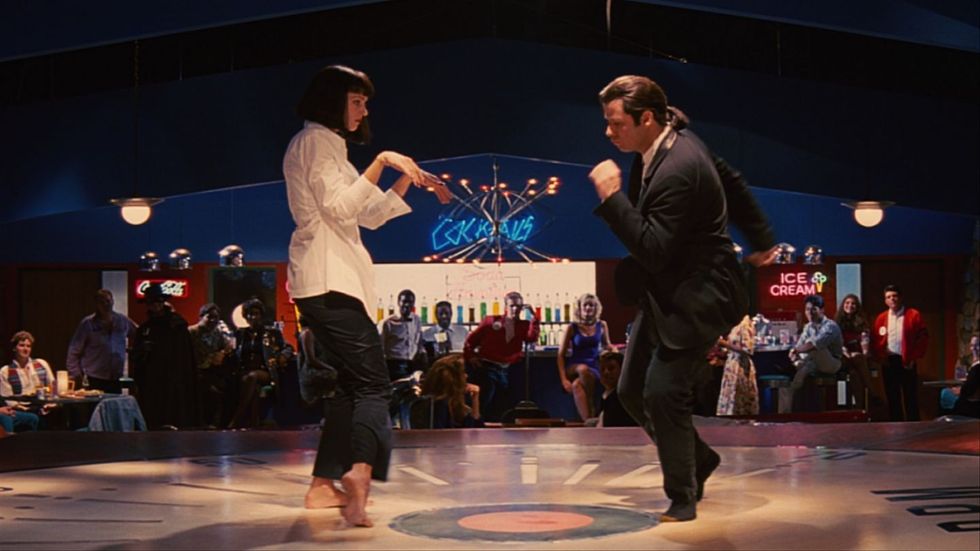
The soundtrack also includes classics like “Son of a Preacher Man” by Dusty Springfield, “Jungle Boogie” by Kool and the Gang, as well as “Let’s Stay Together” by Al Green. The most successful song to chart off the Pulp Fiction soundtrack was Urge Overkill’s cover of “Girl, You’ll Be a Woman Soon” by Neil Diamond. In a year of The Lion King, Forrest Gump, and True Lies, these films were all overshadowed by the lasting staying power of Pulp Fiction’s mesmerizing playlist of a soundtrack.
Many people have valid reasons for hating Quentin Tarantino and Pulp Fiction: his films are hard to understand with their wacky storytelling, his dialog is profane and doesn’t offer much substance to what’s actually happening in the movie, and his soundtracks are just blurry homages instead of catered and produced orchestral film scores. I believe, though, these exact reasons are what make Pulp Fiction. Quentin Tarantino leans into his audience's innate ability to piece together stories and doesn’t dumb things down for us. His dialog is catchy, and his soundtracks define generations as the background sound to films, parties, and daily commutes. His body of work that continues to expand has already inspired a generation of filmmakers. Imagine what he’ll do next!
Have any of you watched Pulp Fiction or any other one of Quentin Tarantino's movies?
Despite all the iconic memes, I am sad to see that pulp fiction doesn't get talked about as much as it should even if it's an older movie. It is still considered an all time classic that'll definitely live through the generations to come. I agree with you that the score is one of the unbeatable sores to match in cinema.
ReplyDeleteYour four new entries are really great, Ezra. You have thoughtful, insightful analysis that is presented logically, cleverly, and engagingly. Your voice shines through, making your personality part of the read and enjoyment. It is clear to your audience that you are connected to your writing, which makes it much easier for them to connect as well. Great work. Keep it up!
ReplyDelete